.webp)


As a GOLFTEC coach, I wear many hats. Teacher, friend, cheerleader, bad guy (reality checker) and therapist. Students need slightly different/nuanced things from me, depending on what stage of their development they are at, and what they are working on. However, the common theme is that everyone is searching for clarity.
Typically speaking, students enter the centre with their perception of their problems and this doesn't always align with the reality of their problems. This lack of clarity can send them searching for answers down dark holes (AKA social media instruction). One of my favourite things about coaching at GOLFTEC is that I have evidence for everything that happens in a lesson and therefore, I don't have to rely on my opinions and feelings, I can use data. When we measure, we don't have to guess, and this is how we can help students gain the clarity they are searching for. We aim to achieve this in all of our golf lesons, but GOLFTEC students also have the ability to practice in the training centre, outside of lesson time. Regular coaching, plus purposeful practice, is a very effective combination. I would like to share more about what I mean by purposeful practice and what it looks like:
You Should Be Targeting Something Specific and Be Able to Measure It
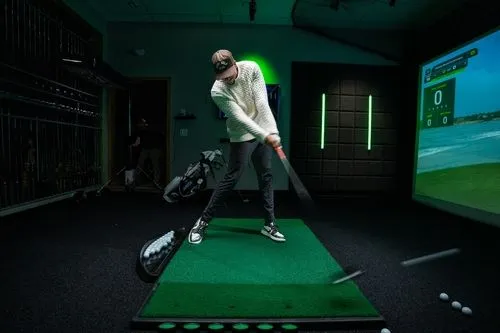
Anyone who has ever met me will appreciate the irony of me using a gym related analogy, but, purposeful practice should mirror a proper gym session. A well-structured gym session will utilize various exercises to target/train a specific muscle group. You quantify what you are trying to do and you track the data so you can monitor your progress. Similarly, a well-structured golf practice session should utilize various drills to target/train a specific fundamental skill (contact, power or direction). For example, the most important fundamental skill in golf is to control your contact, and this has two components; hitting the middle of the face and delivering a downward angle of attack (when using an iron). At GOLFTEC, you can utilize our Foresight GC Quad to get immediate feedback on whether you have achieved your intention.
So, you could start off your practice session with 20 shots, using a pitching wedge, where you do half swings and ensure that you are able to produce centred strike, with a downward angle of attack of more than 3 degrees. If you are more experienced, you could then train by over exaggerating the downward angle of attack and trying to get 'too much' of a downward strike. Most golfers stop when they start achieving the correct amount of a change. Powerful learning occurs when you can establish what too much of a change feels like! Once you have achieved this, you can graduate to bigger swings and longer clubs, to see if you can maintain solid, centered contact.
In summary, go into the practice session with a plan. Decide what you are working on and how you are going to measure it. Are you looking at club data? Are you looking at video feedback? Are you looking for a certain OPTIMOTION number? Regardless, be kind to yourself and judge yourself on one thing at a time. Trying to juggle too many thoughts at once is unlikely to end well.
Use Constraints/Manipulators to Force the Change
A massive challenge with golf is that what we feel we are doing and what we actually are doing are often two different things. Therefore, it is sometimes difficult to know where your club is in space, when you are moving at full speed. A great way to force the change is to utilize constraints in your practice, so that you are required to manipulate your movement in order to succeed. These manipulators also tick the purposeful practice box, because they provide immediate feedback. For example, placing a towel 10cm behind the ball lets you know right away, if you hit the ground too early. The pool noodle outside the ball forces you to swing more in to out. If you have to keep picking it up, you know you are swinging out to in!
Using drills like these are an excellent way of learning what a different (and often better) way of swinging feels like to you, whilst receiving feedback with every shot.
Vary Your Practice and Try to Create Some Competitive Pressure
Whilst hitting 20 balls in a row in drill form (block practice) is very useful for skill acquisition and confidence building, it is important that a portion of your practice session reflects the challenges that you face when you play on the course (random practice). Typically speaking, you only use the same club twice in a row when you are putting, or when you have just smashed your first ball out of bounds. Hitting the same shot at the same target time and time again from a driving range/studio mat really doesn't reflect the challenges that you are going to face on the course. We need to be able to move from club to club without losing our contact, because unlike other sports like tennis, we don't have the luxury of a second serve. At GOLFTEC, there are a variety of play modes that allow you to practice with purpose. You can use the YARDAGE RANDOMIZER, which does what it says on the tin. You set the distance range you want to work on (for example, 50-150 yards) and the distance changes after every shot. You can play virtual courses which allow you to recreate the real thing. Or, you can design your own skills challenge, which could look something like:
- 50 yards, 75 yards, 100 yards, 125 yards, 150 yards
- 3 balls to each target
- Tally my accumulated proximity to the hole
- Note your personal best and try to beat it from week to week
This sort of practice helps you create competitive pressure and ensure that each ball means something in your practice session. It helps you create some of the feelings that you will experience on the course. Preparing yourself for these nerves is the only way to get more comfortable with them when it really matters.
Want to start practicing with a plan? Book a session at GOLFTEC Hong Kong and let us show you exactly what to work on — and how to measure it. Or explore our coaching pakages to find the right program for your goals.